
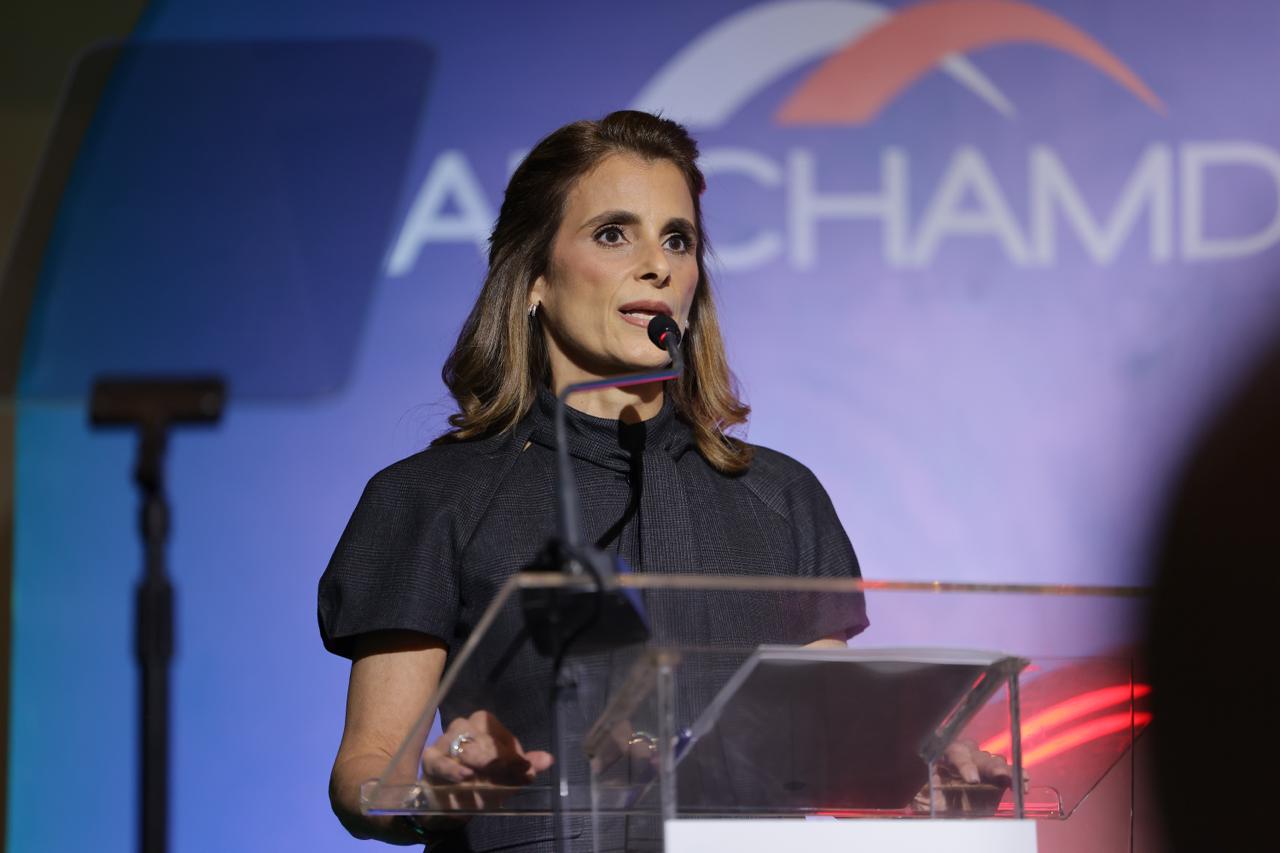
The executive stated that the Dominican Republic’s growth, although successful, has largely been shaped by favorable circumstances and strategic decisions made in the past. Today, that model faces its greatest test.
Santo Domingo, Dominican Republic. — Business leader Ligia Bonetti stated that the country is facing a historic opportunity to position itself as a strategic nearshoring destination, but warned that the outcome will depend on structural decisions that must be made in the short term.
The Executive President of Grupo SID shared her perspective during her participation in the monthly luncheon of the American Chamber of Commerce of the Dominican Republic (AMCHAMDR).
She noted that the international landscape has changed rapidly, driven by geopolitical tensions, new trade policies, and the reconfiguration of global supply chains. This scenario has opened a clear window for the relocation of manufacturing operations to markets closer to the United States, where the Dominican Republic stands out as a relevant candidate.
“The question is no longer whether the opportunity exists, but whether we are prepared to respond,” Bonetti stated, emphasizing that the country’s positioning will not be automatic or guaranteed.
During her remarks, she highlighted that the Dominican Republic’s sustained economic growth in recent decades has been linked to strategic decisions that gave rise to key sectors such as tourism and free zones. These pillars, she explained, did not emerge spontaneously, but rather as a result of deliberate public policies that facilitated investment, promoted competitiveness, and generated employment.
Based on this experience, Bonetti suggested that the current challenge is to replicate that model toward industrial development and nearshoring attraction, which implies reopening the discussion on enabling conditions for new productive sectors.
“We must ask ourselves why it is so difficult to open that same discussion for industrial development at this time,” she stated.
Despite this context, she highlighted that Dominican manufacturing has shown positive performance, with sustained growth and export capacity, demonstrating the existence of a productive ecosystem with expansion potential. “Free zones are the gateway. The local ecosystem is the house. And that house is not yet fully built,” she expressed.
As part of her assessment, Bonetti identified three structural gaps that, in her view, will define the country’s ability to compete in this new stage.
The first is technological credibility. She warned that competitiveness no longer depends solely on individual efforts, but on the ability to build functional innovation ecosystems articulated among the public sector, private sector, and academia.
The second gap relates to energy competitiveness. A strategic vision is required to encourage decision-making. The country already has a regulatory framework; now it is necessary to activate, through a public-private effort, an articulated energy agenda and advance the development of a sustainable roadmap aligned with national needs.
The third is the speed of talent development. Beyond access to education, Bonetti emphasized the need to accelerate the training of technical, bilingual, and certified human capital capable of meeting international manufacturing standards in the short term.
In addition to these factors, the business leader stressed that the main challenge is execution. She recalled that the recent fiscal reform discussion demonstrated the private sector’s ability to influence the public agenda. However, she noted that the current challenge is different.
In this context, she called for taking advantage of this window of opportunity and building an agenda over the next 24 months aimed at articulating a national nearshoring strategy. She added that the opportunity is finite and unfolding in real time, so inaction could result in a loss of positioning compared to competing markets in the region.
Nevertheless, she concluded that this outcome will not depend on the external context, but on the internal capacity to make strategic decisions with a sense of urgency.
“The opportunity is happening now. If we fail to respond, it will not be due to a lack of opportunity, but a lack of preparation,” she emphasized.
In this context, Francesca Rainieri, President of AMCHAMDR, stated that the Dominican Republic has built, hand in hand with the public and private sectors, an agenda aimed at strengthening its positioning in nearshoring and consolidating itself as a regional logistics hub. However, she noted that “challenges remain, barriers we must overcome, and opportunities to capitalize on to attract more investment and leverage our country’s competitive potential.”
For his part, the Chamber’s Executive Vice President, William Malamud, affirmed that the country is well positioned to take advantage of the global restructuring of supply chains, supported by its strong relationship with the United States and the broader region, highlighting the Dominican Republic as a safe and reliable regional partner.
The event brought together business leaders and representatives from various productive sectors in a discussion focused on how to transform the current international context into a sustainable development strategy for the country.
