
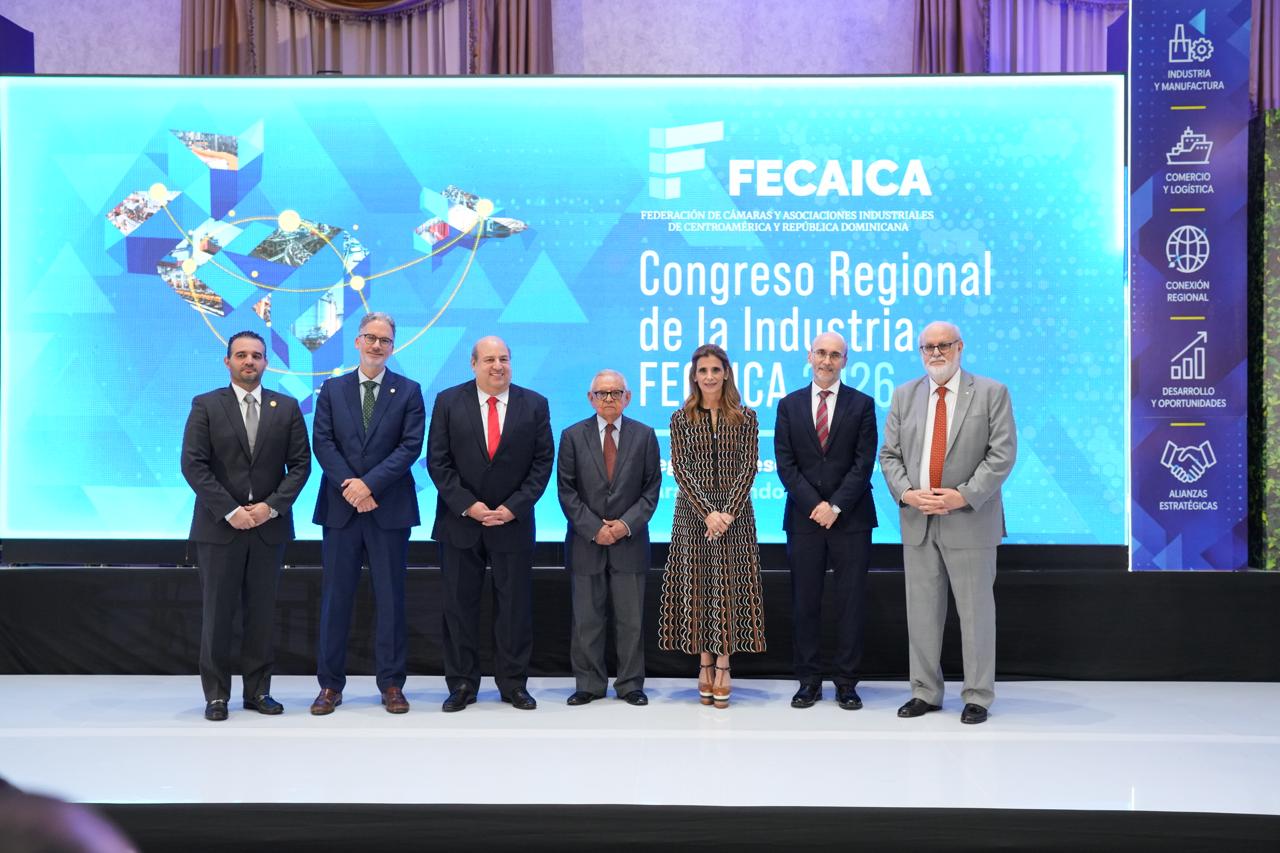
Grupo SID’s Executive President proposed bringing together businesses, governments, industry associations, and academia to develop talent, harness data, strengthen production capabilities, and focus investment on strategic sectors.
SAN SALVADOR, El Salvador. Grupo SID’s Executive President, Ligia Bonetti, participated in the FECAICA Regional Industry Congress, where she proposed developing a joint industrial agenda for Central America and the Dominican Republic, with a ten-year horizon, verifiable targets, and clearly defined commitments to transform the region’s productive potential into sustainable competitive advantages.
In her keynote address, titled From Opportunity to Competitiveness: Industrial Leadership to Build a Regional Platform with Global Reach, she argued that industrial development in 2036 will depend on the decisions that businesses, governments, and academic institutions make today to anticipate technological change and strengthen the region’s capabilities.
To explain her proposed roadmap, Bonetti guided the audience through five lines of action: co-create, scan, reprogram, compete, and take responsibility.
A shared strategy for industry
As a first step, Bonetti proposed that each government appoint a representative to work alongside the industrial sector in developing this agenda. It should define the capabilities the region seeks to develop, each country’s contributions, and the results to be reviewed annually. She proposed presenting progress at the next FECAICA Regional Industry Congress and invited academia and international organizations to join the initiative.
The proposal seeks to strengthen regional coordination and provide businesses with greater predictability when making investment decisions, developing suppliers, and planning their talent needs.
Data, technology, and talent as drivers of productivity
Another pillar of the proposal is to harness the information generated daily by factories, customs authorities, and ports to improve decision-making and direct investment toward tangible results.
Bonetti noted that although the region has more technological tools at its disposal than in the past, challenges persist in innovation, research and development, and productivity. She therefore stressed the need to use available information to identify opportunities, measure progress, and direct investment toward tangible results.
Citing the World Economic Forum’s Future of Jobs Report 2025, she indicated that 39% of current skills could change or become obsolete by 2030, while 63% of surveyed employers consider skills gaps a major barrier to transforming their businesses.
In response, Bonetti proposed promoting workforce reskilling so that employees can update their skills and adapt to new technologies. She emphasized that this process must go beyond technical training to incorporate skills such as the ability to learn and adapt, critical thinking, and sound judgment.
Identifying where to compete and making commitments
On investment, Bonetti argued that the region must identify the sectors in which it already has production experience, accumulated expertise, and opportunities for international growth. The capabilities she highlighted included agribusiness, food, textiles, apparel, and medical devices.
She proposed identifying two or three strategic links in value chains where countries can combine their strengths and concentrate resources on training, applied research, and productive investment.
As a reference, she discussed Taiwan’s experience in the semiconductor industry, highlighting how specialization and sustained commitment to a particular segment of the value chain can help build an internationally competitive position.
Bonetti emphasized that developing a regional platform with global reach also requires taking responsibility, establishing measurable commitments, and being accountable for results.
Referring to Grupo SID, which is approaching its 90th anniversary, she highlighted each generation’s responsibility to reassess inherited decisions and prepare the organization for future challenges.
She concluded with a call to strengthen collaboration among countries under the concept of CERCA—Spanish for “close”—an acronym formed from the initials of the five lines of action presented in her address: cocrear, escanear, reprogramar, competir, and asumir.
“Being CERCA allows us to compete on the world stage as a single region,” she said, inviting business and institutional leaders to turn the opportunities identified into a shared working agenda.
