
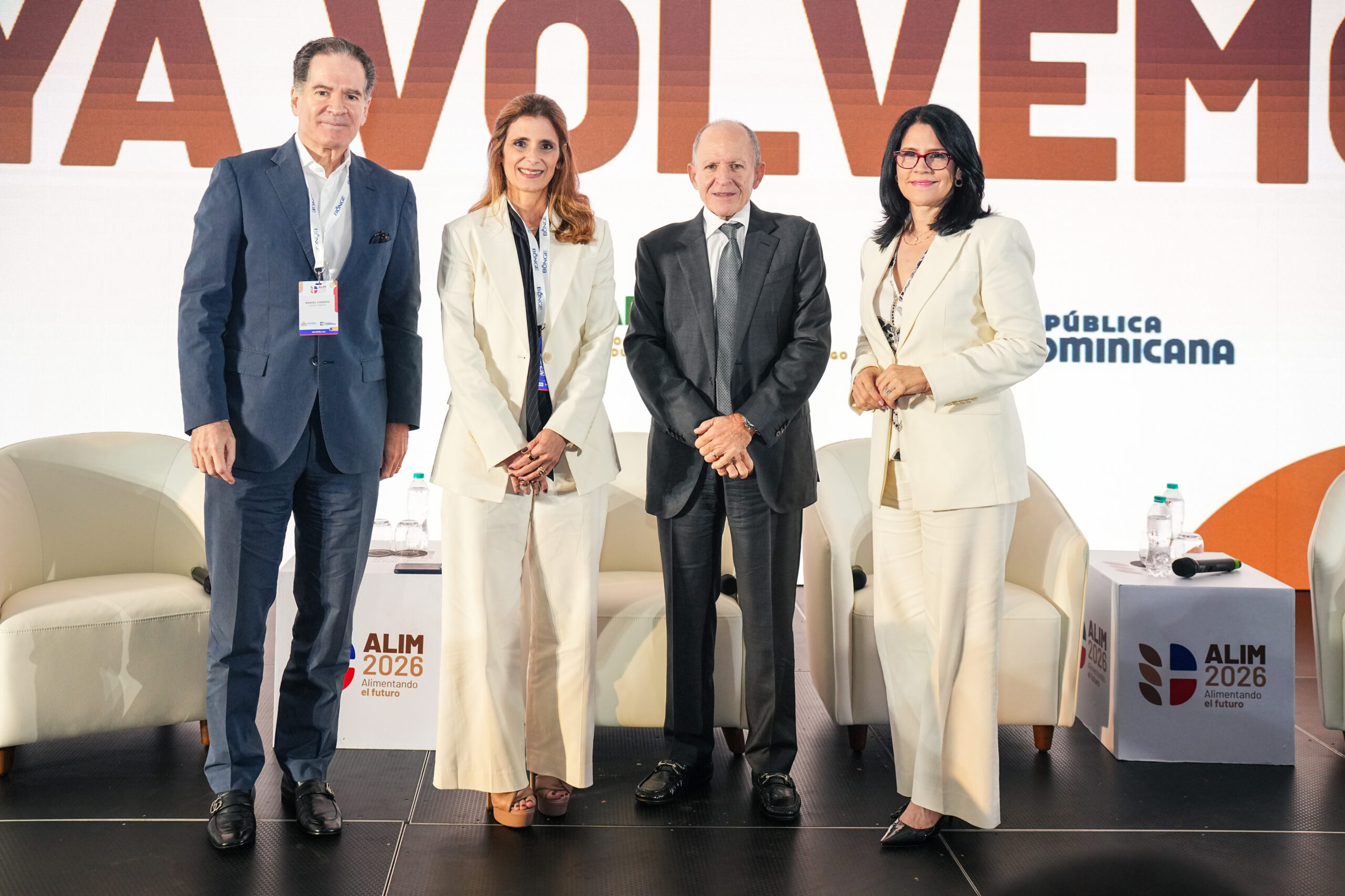
The Executive President of Grupo SID addressed the challenges of generational succession alongside Manuel Corripio and Juan José Gutiérrez Mayorga during the annual meeting of the milling industry in Latin America and the Caribbean.
Punta Cana, Dominican Republic, November 23, 2026. Ligia Bonetti, Executive President of Grupo SID, argued that capability and preparation should guide the selection of individuals who will assume new responsibilities within a family business. Bonetti discussed this topic during a panel titled “The Challenges of Generational Succession in Family Businesses,” held at Casino Punta Cana as part of the annual meeting of the Latin American Association of Milling Industries (ALIM 2026).
Bonetti participated at the invitation of the Dominican Association of Wheat Milling Industries (ADOTRIGO) and shared the panel with Manuel Corripio and Juan José Gutiérrez Mayorga. All three belong to the third generation of their respective business families.
Reflecting on the history of Grupo SID—a conglomerate formed by three families: the Bonettis, the Armenteros, and the Vitienes—Bonetti highlighted the contributions of professionals who have been part of the organization since its inception, both from within and outside the family circle. “When it comes time to entrust someone with a responsibility, we must look beyond the surname and recognize the talent that will help us go further. Furthermore, it is the duty of our generation to pass on to those who follow the values we received and the lessons we learned from those who led the company before us,” she noted.
Bonetti also challenged the common belief that the arrival of the third generation inevitably leads to the failure of a family business. She acknowledged the difficulty of maintaining a consistent pace of growth and pointed out that leadership succession creates an ongoing task for the business family: the way its members organize themselves, distribute responsibilities, and make decisions must evolve alongside the company. Among the competitive advantages of family businesses, Bonetti highlighted the diversification of their operations and the close ties between generations. Regarding the latter, he explained that those currently in leadership positions can consult their predecessors and learn firsthand about the circumstances and criteria that shaped the decisions defining the company’s trajectory.
This closeness, he added, also entails a commitment for those currently at the helm of the business. It falls to their generation to pass on to the next—both the values they inherited and the knowledge accumulated by those who came before them.
Looking ahead to 2036, Bonetti noted that one of the challenges for family businesses will be attracting young people who could eventually take on leadership roles, while providing them with the space to develop their own projects and contribute to the country through the company. “Preparing the next generation is just as important as ensuring they want to join in the first place,” she stated.
